Upstream & Downstream | Mindfulness, Trauma Healing & Emotional Awareness by Jiu Jian
A reflective mindfulness and healing journey exploring trauma, emotional awareness, upstream vs downstream living, nervous system healing, mindfulness, voice work and inner transformation by Jiu Jian’s Mindfulness Vocal & Healing Sanctuary.
Jiu Jian
5/27/20264 min read
Upstream & Downstream — Are We Too Busy Saving Ourselves to Understand Why We Keep Falling?
上游与下游 —— 我们是否忙着救火,却忘了寻找源头?
There is a contemporary fable often used in psychology, mindfulness teachings, trauma-informed care, suicide prevention and public health discussions called “Upstream / Downstream.”
The story is widely attributed to wellness educator Donald D. Ardell, PhD, and has since been adapted into various mindfulness and MBSR (Mindfulness-Based Stress Reduction) teachings by practitioners .
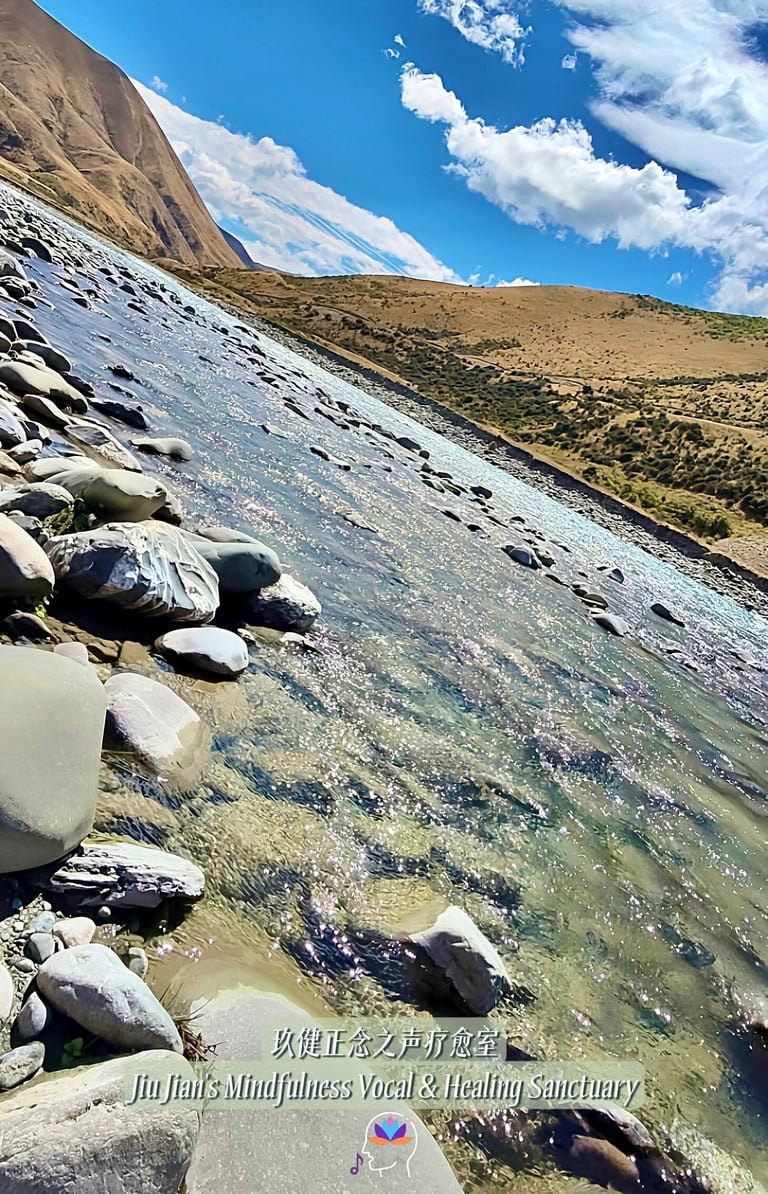
In the story, villagers living downstream became increasingly busy rescuing drowning people floating along the river.
Over time, they built hospitals, rescue systems, emergency teams, boats and highly trained swimmers. Everyone became exceptionally skilled at saving lives downstream.
Until one person finally asked:
“Why don’t we walk upstream and find out why people keep falling into the river in the first place?”
Simple. Yet deeply confronting.
Because perhaps this story is not only about healthcare, psychology or social systems.
Perhaps it is also about us.
Have We Been Living Mostly Downstream?
At one point in our lives, did we realise that most of our time was spent managing consequences rather than understanding causes?
We became highly efficient at:
solving emergencies
repairing broken situations
recovering from heartbreaks
paying for wrong decisions
fixing emotional collapses
surviving stress after damage was already done
But very few of us were ever taught how to pause long enough to ask:
“Where did all these begin?”
In modern life, many of us only start listening to the body after burnout happens.
We only learn about rest after insomnia.
We only value emotional connection after relationships become distant.
We numb stress through endless scrolling, shopping, overworking, distractions, addictions or unhealthy coping patterns — not necessarily because we are weak, but because most of us were never taught how to sit with discomfort safely.
Some people spend decades changing jobs, environments or relationships without realising the deeper dissatisfaction may not be external alone.
Others spend half a lifetime trying to prove their worth because of unresolved childhood wounds they never knew existed.
The human nervous system itself is wired for survival.
Fight. Flight. Freeze.
When stress appears, the brain naturally prioritises immediate protection rather than deep reflection. Combined with the speed and pressure of modern society, many people simply do not have the emotional space or safety to explore the roots beneath the symptoms.
So we continue living downstream.
Busy surviving.
Busy coping.
Busy rescuing ourselves.
My Own Journey — Living Downstream for Half My Life
When I look back at my own life today, I realise that a large part of my earlier years was spent living downstream.
Much of my emotional energy went into surviving the aftereffects of unresolved childhood traumas, family conditioning, identity struggles and the consequences of unconscious choices made while still carrying unseen emotional wounds.
From the outside, life may at times have appeared like a completed skyscraper.
Career.
Achievements.
Experiences.
Recognition.
But deep within, the foundation was fragile.
Eventually, parts of the structure cracked.
Some parts collapsed. And life demanded rebuilding. But healing did not happen overnight.
In many ways, it felt like peeling a giant onion layer by layer.
Psychological conditioning.
Inner child wounds.
Fear.
Shame.
Attachment.
Identity.
Suppressed emotions.
Unprocessed grief.
Each layer revealed another deeper root beneath the surface.
Perhaps fortunately — though much later than I wished — by my late 30s, I slowly began realising that healing, rewiring and rediscovering oneself was still possible.
Looking back today, I do not think strength alone carried me through.
I was fortunate to encounter different teachings, teachers, practices and life experiences at various stages of my journey.
Mindfulness.
Meditation.
Yoga.
Psychological awareness.
Voice work.
Hypnosis.
Silence.
Nature.
Even pain itself became a teacher.
From a Buddhist perspective, perhaps there was also a certain 波罗蜜 (Pāramī) — the accumulated causes, conditions and wisdom that allowed me to gradually awaken, endure and continue sailing through the storms instead of drowning within them.
Even then, rebuilding took far more time, humility and courage than I could ever imagine.
Sometimes we think collapse is the end.
But occasionally, collapse is also the beginning of finally rebuilding the right foundation upstream.
Why I Chose Mindfulness, Voice & Healing Work
This is also why mindfulness eventually became deeply important in my life and work.
Especially approaches such as MBSR (Mindfulness-Based Stress Reduction), together with voice awareness, yoga, meditation, hypnosis and transformational coaching.
These approaches do not merely help individuals “solve problems.”
They help strengthen the upstream.
The foundations.
The nervous system.
The emotional backbone.
The ability to observe oneself before collapsing.
To me, voice itself eventually became more than performance.
It became a pathway back to presence.
Through mindfulness and somatic awareness, individuals may begin noticing emotional suffering, stress patterns and inner disconnection much earlier — before life fully breaks downstream.
This understanding became even more meaningful during my training related to emotional support and suicide prevention work.
Because often, the most important intervention does not begin during crisis itself.
It begins much earlier.
During the quieter moments when someone slowly starts losing connection with hope, meaning, safety or themselves.
Sometimes upstream work is not dramatic.
It may simply begin with:
listening
awareness
slowing down
emotional safety
compassionate presence
helping someone feel seen before they completely disappear within themselves
Upstream & Downstream Must Work Together
Yet upstream and downstream are never enemies. Both are necessary.
Hospitals are important downstream. But healthy lifestyle awareness is important upstream.
Therapy and crisis intervention are important downstream.
But emotional literacy, safe conversations and self-awareness are important upstream.
Emergency rescue matters downstream.
But prevention, connection and early support matter upstream.
When either side weakens, the entire river suffers. Perhaps what humanity truly needs today is not merely faster rescue downstream —but clearer waters upstream.
Waters clear enough to nourish the land. To awaken forgotten parts of ourselves. And to allow transformation to happen naturally once again.
Clarity · Awaken · Transform
— Jiu Jian’s Mindfulness Vocal & Healing Sanctuary
Let Healing Begin with the Sound
Suggested References
Donald D. Ardell, PhD — High Level Wellness: An Alternative to Doctors, Drugs and Disease